Audit Overview
Your store's untapped revenue potential — and how to unlock it
Why We Created This Audit
We analyzed bewakoof.com the same way we've audited 350+ e-commerce stores — looking for the specific gaps between your current experience and what top-performing Fashion stores deliver. Every finding in this report is a revenue opportunity backed by industry data and competitive benchmarks.
What We Analyzed
- UX & Conversion Design15 findings
- Technology & App StackPlatform + 4 apps
- Industry BenchmarksFashion
Pages Analyzed
- Homepage3 findings
- Collection Pages4 findings
- Product Pages (PDP)5 findings
- Cart & Checkout3 findings
 This audit was prepared by Growisto — a CRO-led Website development team behind 167% conversion growth for Atomberg, 46% CR lift for TyresNmore, and 350+ e-commerce projects.
UX & Conversion Findings
Page-by-page analysis with visual comparisons against top Fashion stores
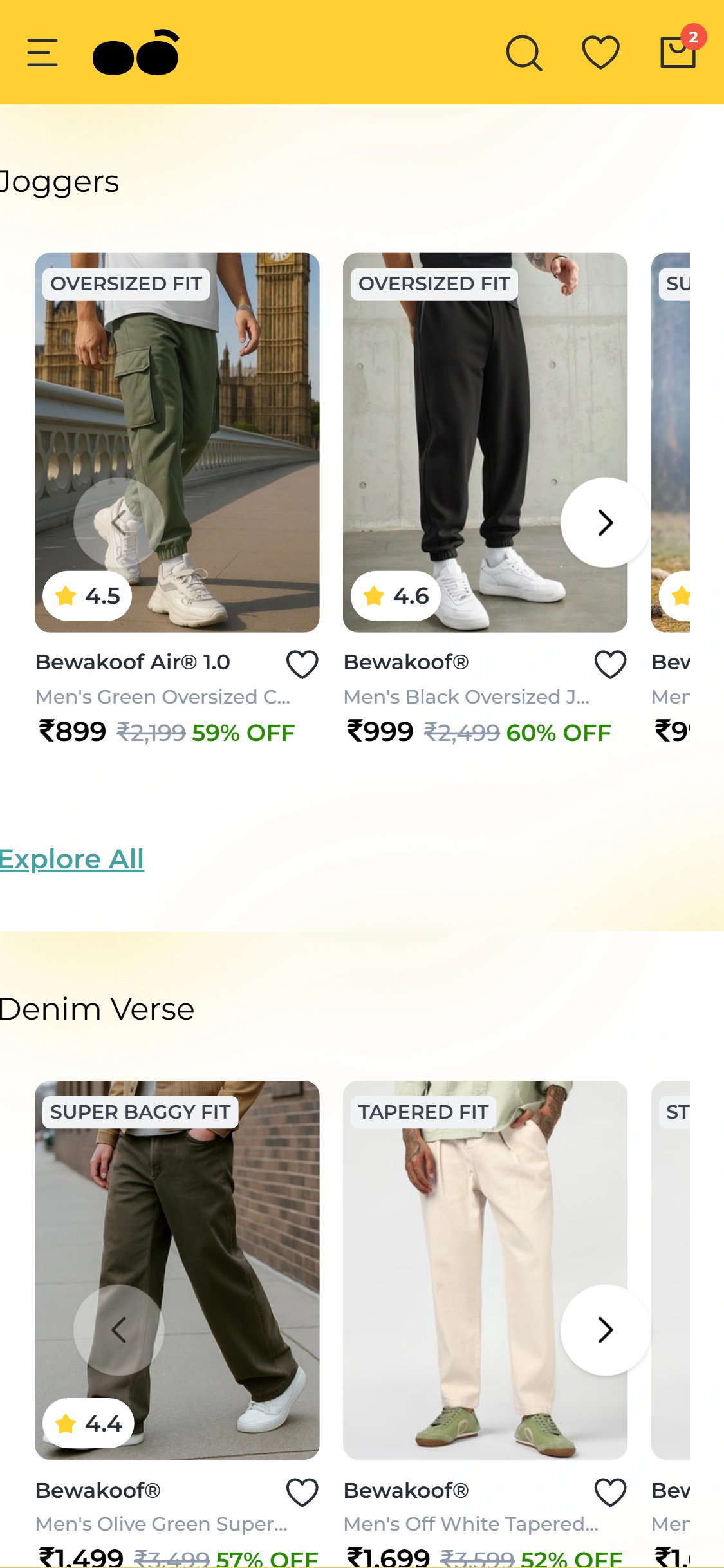

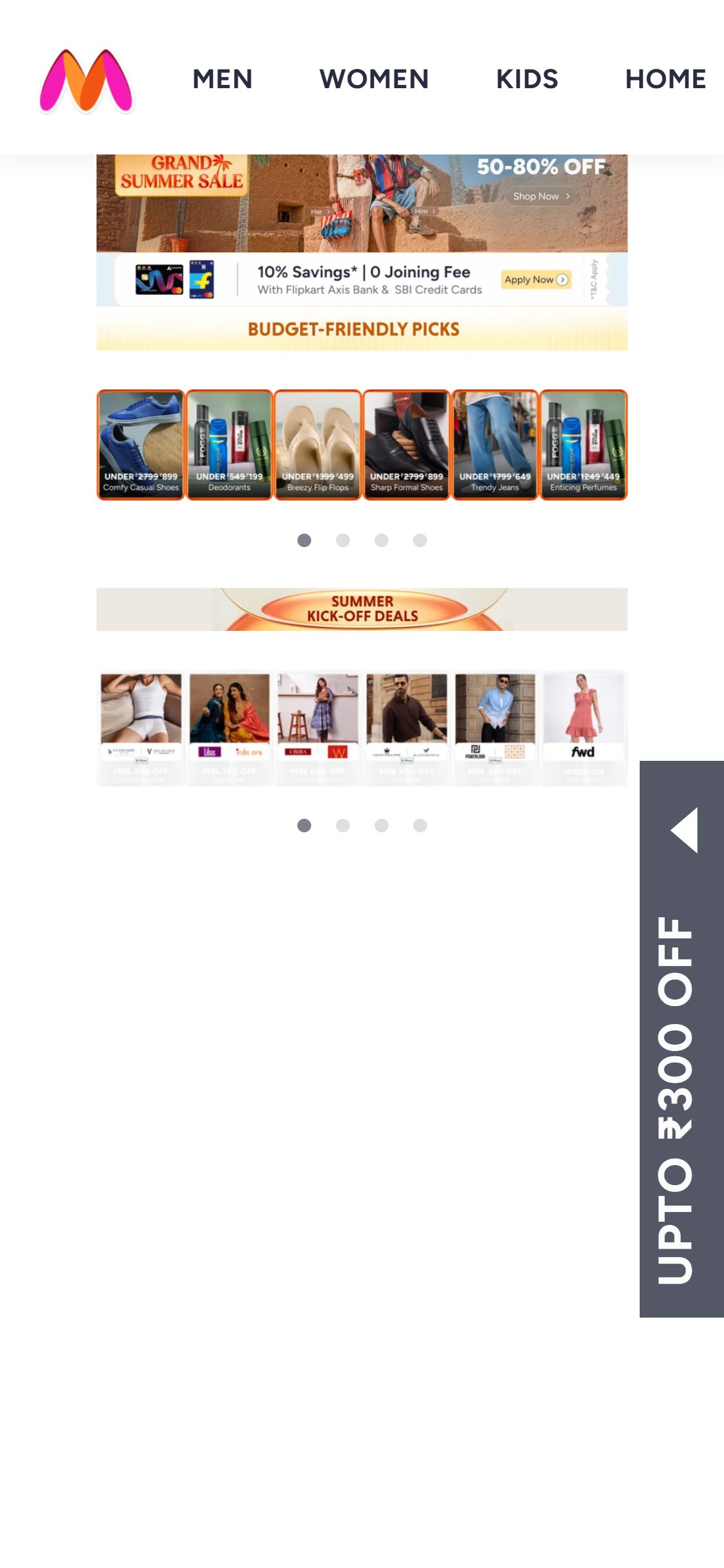
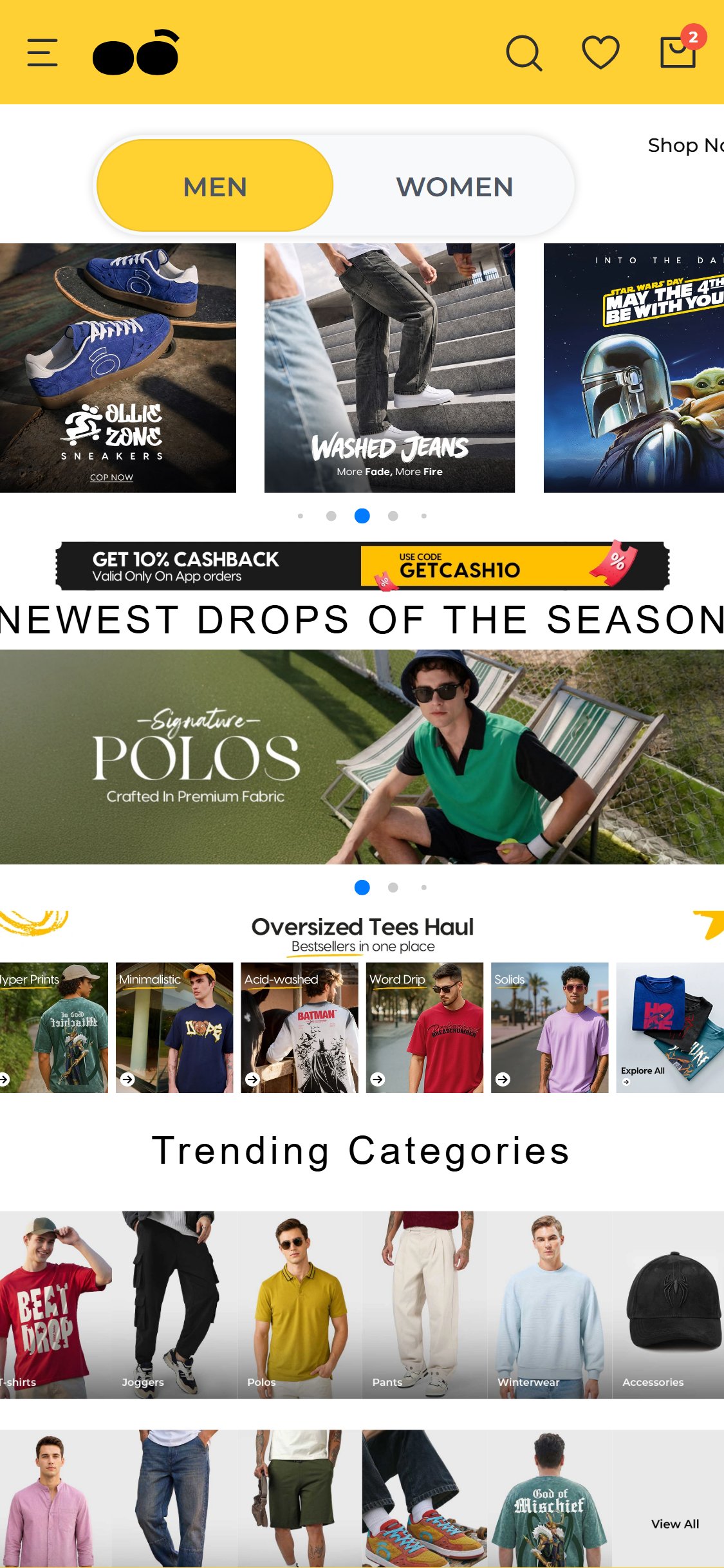
- No persistent announcement bar is pinned to the top of the page on scroll
- Offer messaging (discounts, free shipping threshold) is buried inside the hero carousel
- Users who scroll past the hero have no persistent reminder of active promotions
- Competing fashion brands use sticky promo bars to reinforce discount urgency throughout the session
- Add a slim sticky bar (28–32px) at the very top that persists on scroll, carrying the best active offer or free-shipping threshold
- Rotate 2–3 messages (offer, free shipping, easy returns) using a marquee or auto-play to maximise information density without layout cost
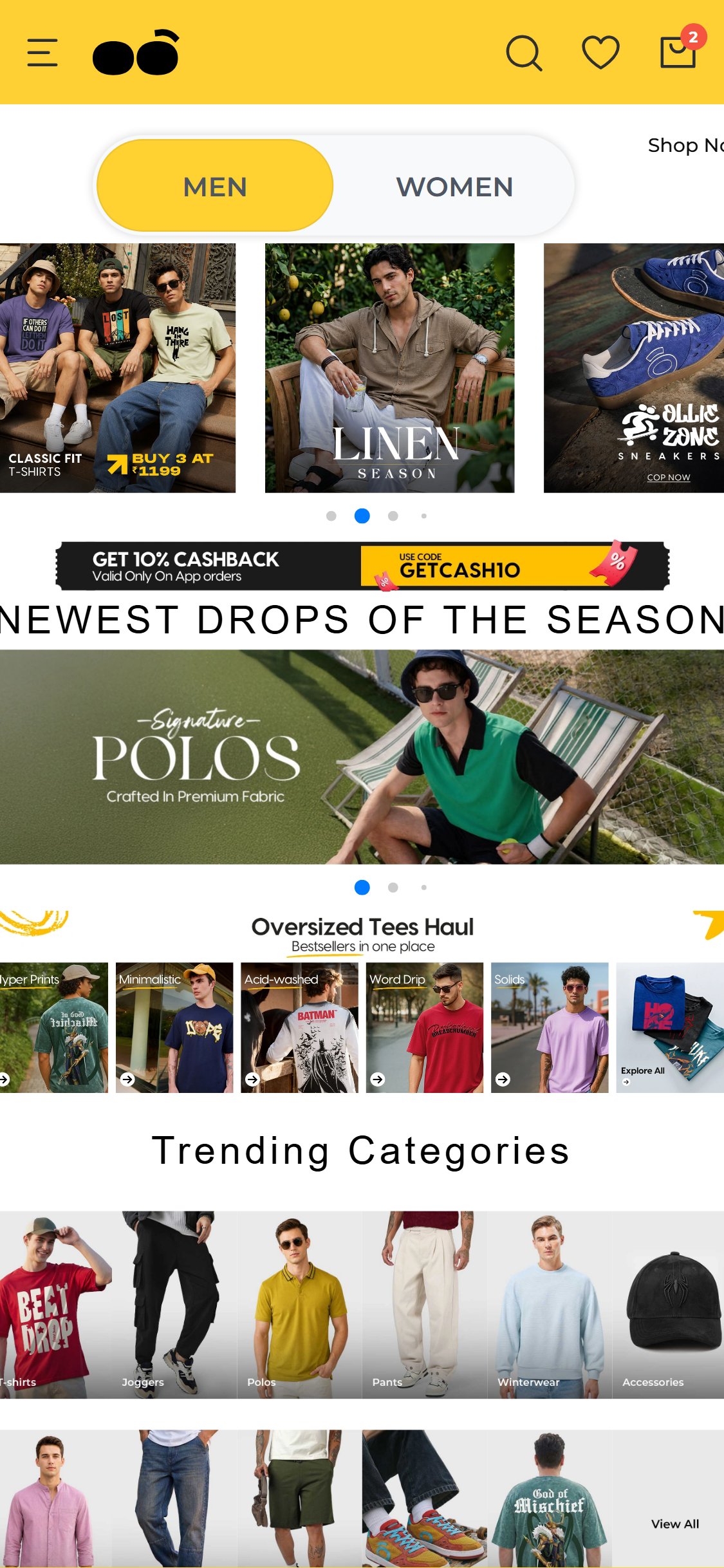
- Hero carousel slides are primarily lifestyle imagery with minimal overlay text
- CTA buttons (where present) use generic labels such as 'Shop Now' without offer context
- No discount percentage, end-date urgency, or category specificity is visible on hero slides
- Mobile viewport clips further reduce text legibility on smaller devices
- Overlay each hero slide with a short offer headline (e.g. 'Flat 40% OFF Graphic Tees') and a specific CTA ('Shop Tees →') that deep-links to the relevant collection
- Include a countdown timer or 'Ends Tonight' label for time-sensitive campaigns to inject urgency
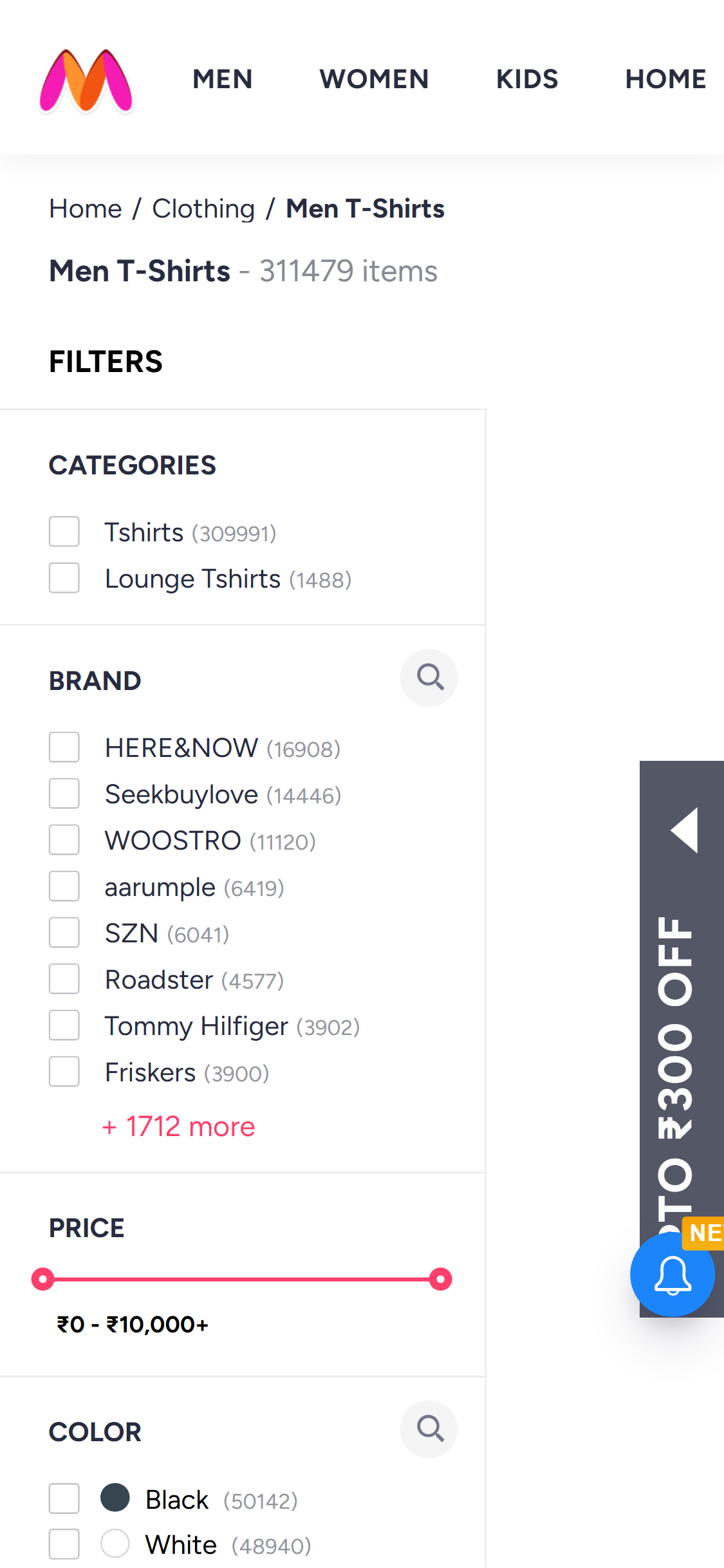
- Tapping the search icon opens a plain text field with no instant suggestions
- No trending searches, recent searches, or category shortcuts are surfaced
- Users must type a complete query before any results appear — this is friction on mobile keyboards
- Screenshot HP02_search_predictive.jpeg confirms a static search box with zero suggestion UI
- Implement a predictive search overlay that shows trending products, top categories, and query completions after 2+ characters are typed
- Surface 'Popular searches' and recent history chips immediately on search tap, before any typing, to guide discovery
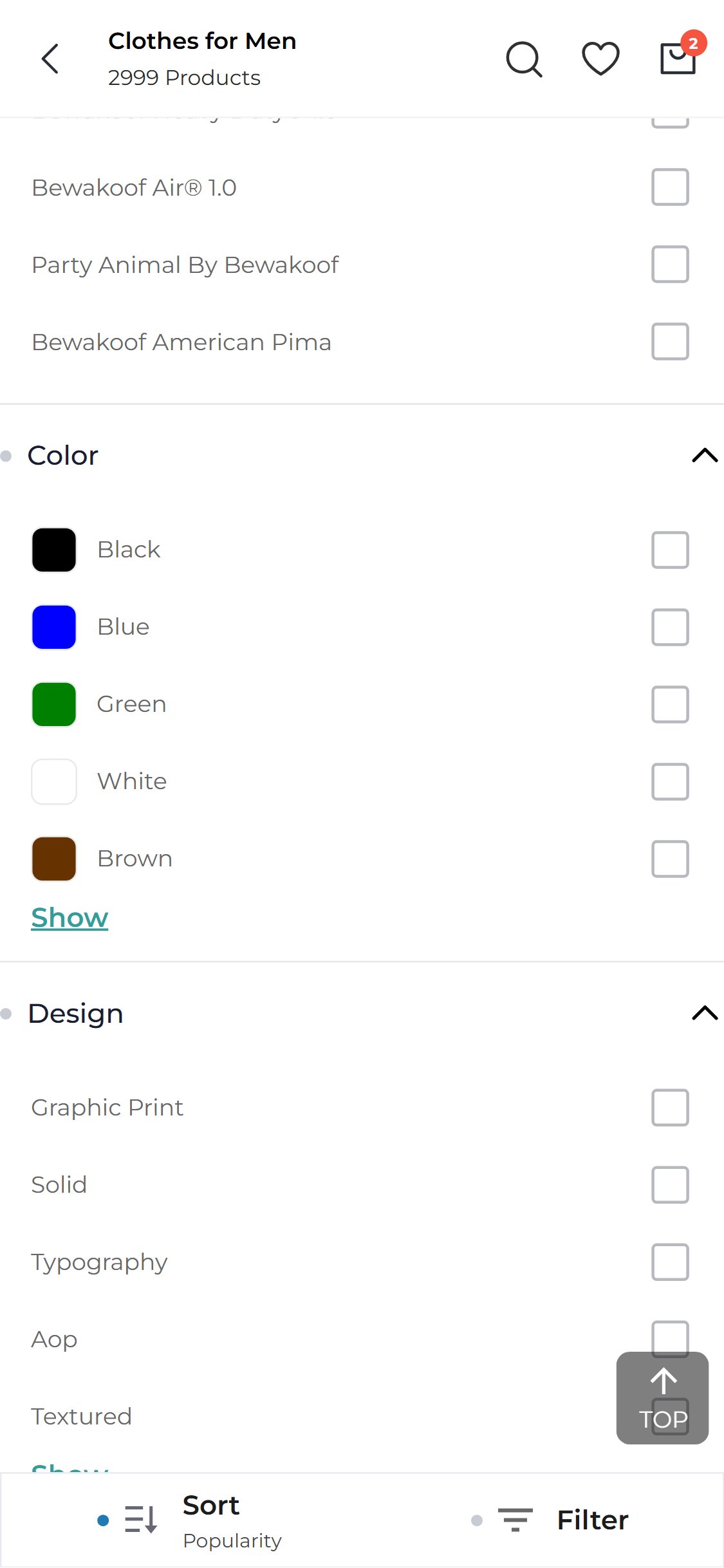
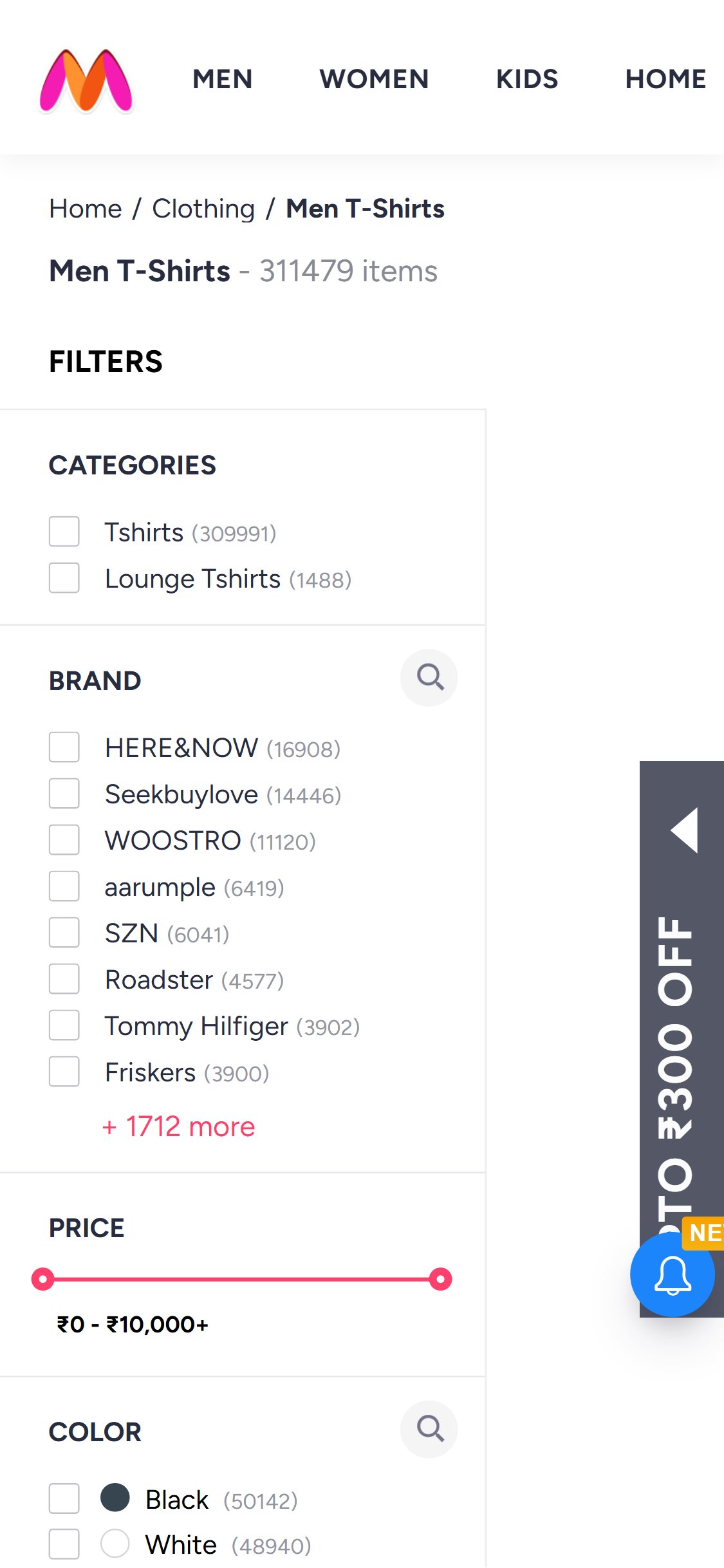
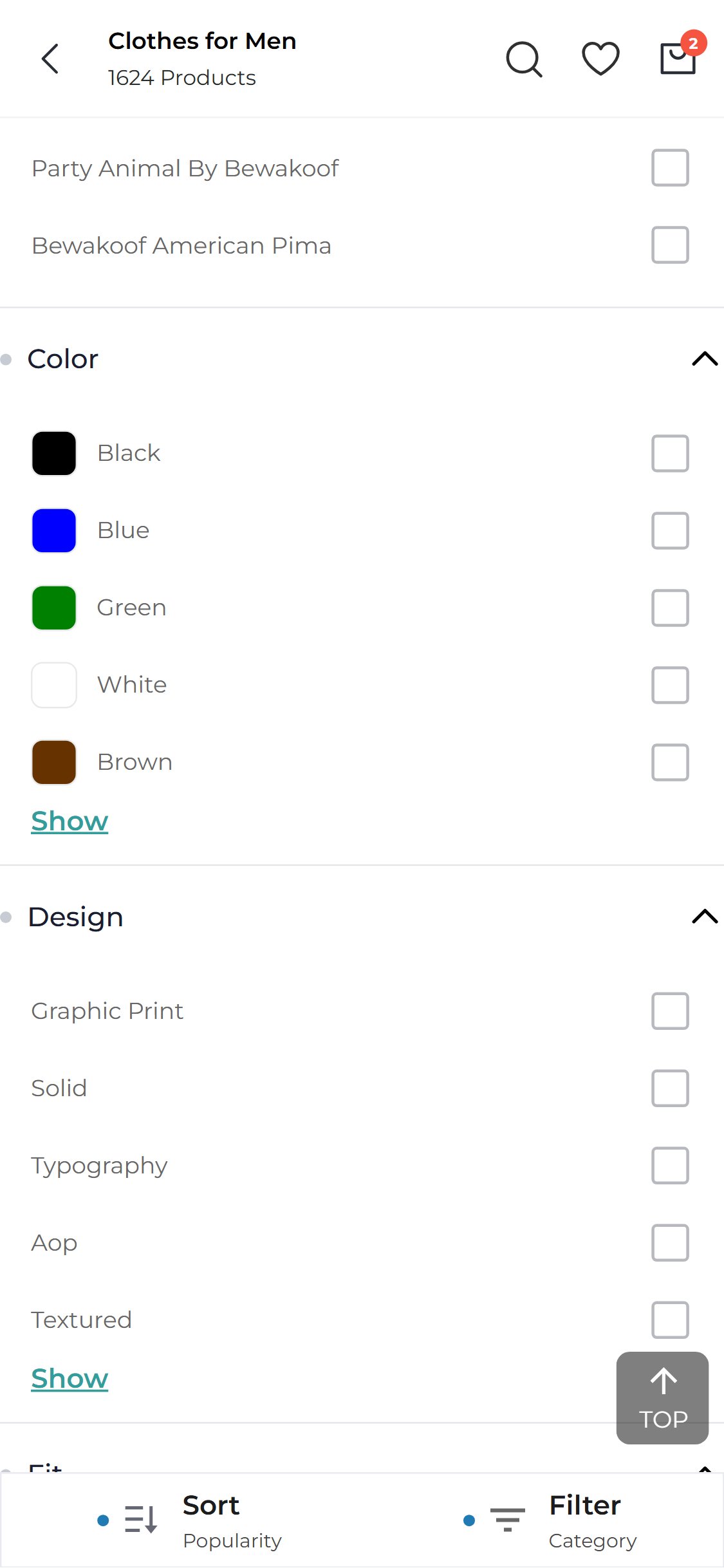
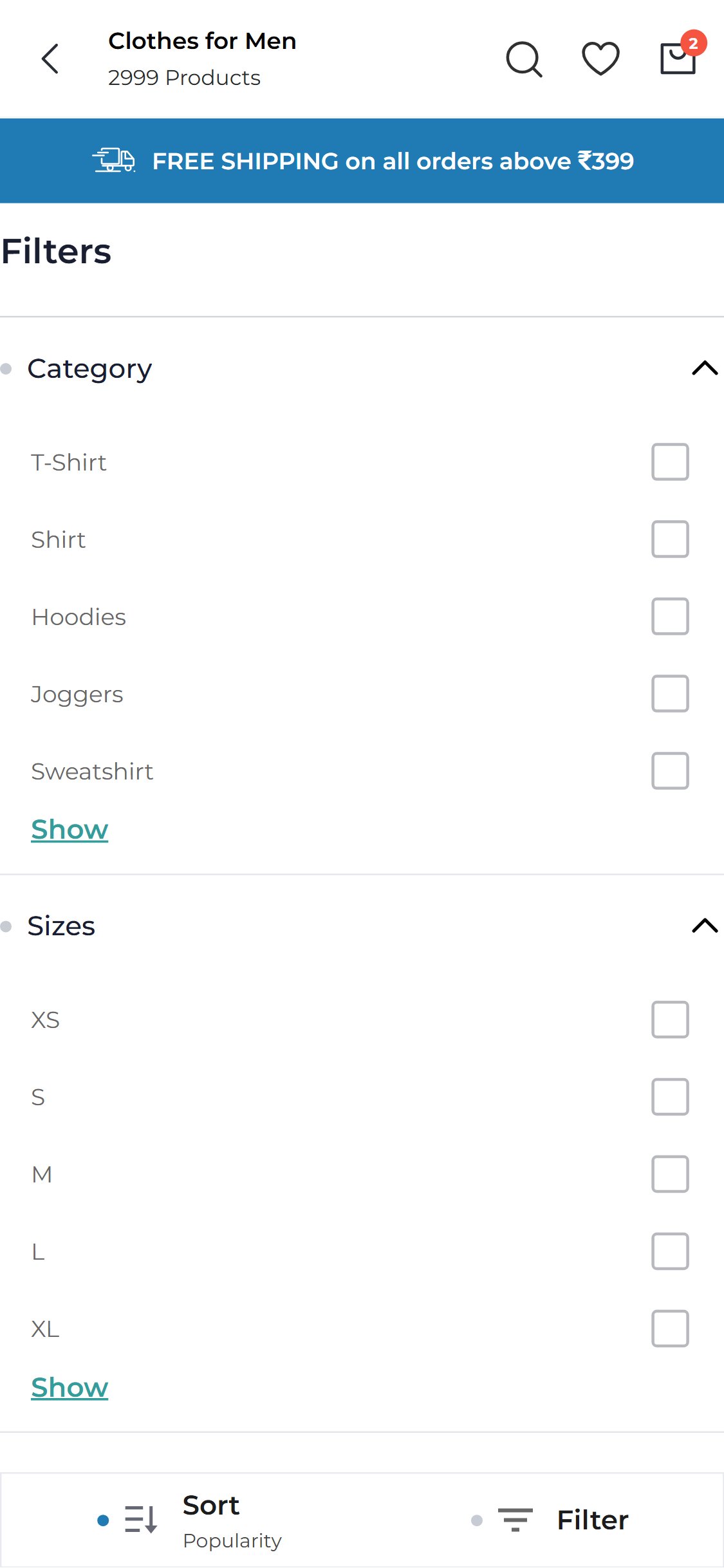
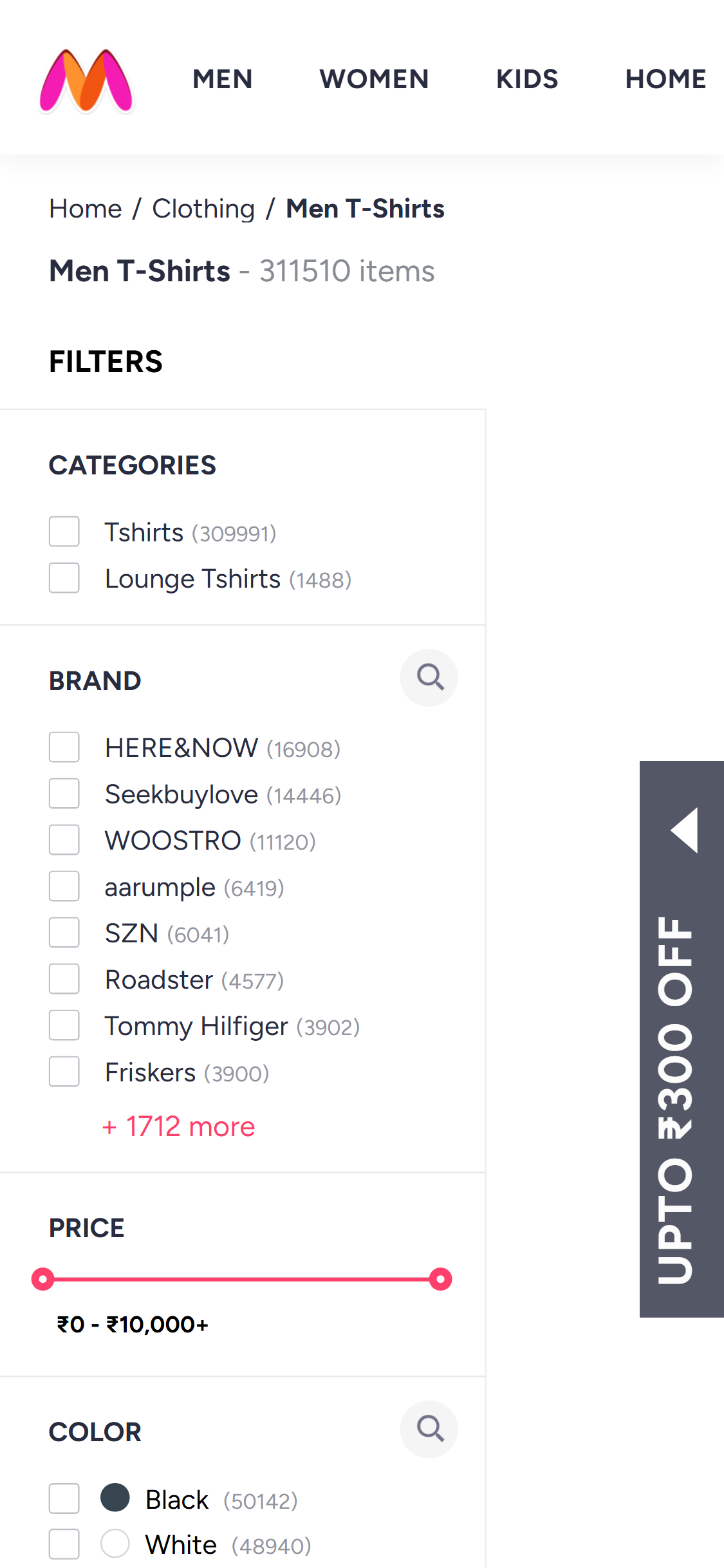
- Collection pages display minimal filter options — primarily price range with few attribute facets
- No size, colour, fit, sleeve-length, or occasion filters are exposed in a collapsible panel
- The 'collection_price_filter.jpeg' screenshot confirms only a basic price slider is available
- Users with specific fit or colour requirements cannot narrow results and leave to find a better-filtered experience elsewhere
- Build a slide-up filter drawer on mobile with attribute facets (Size, Colour, Fit, Sleeve, Occasion, Price) and apply-without-reload using URL params
- Show active filter chips below the toolbar and a result count ('120 products') that updates as filters are applied to reassure users they are narrowing effectively
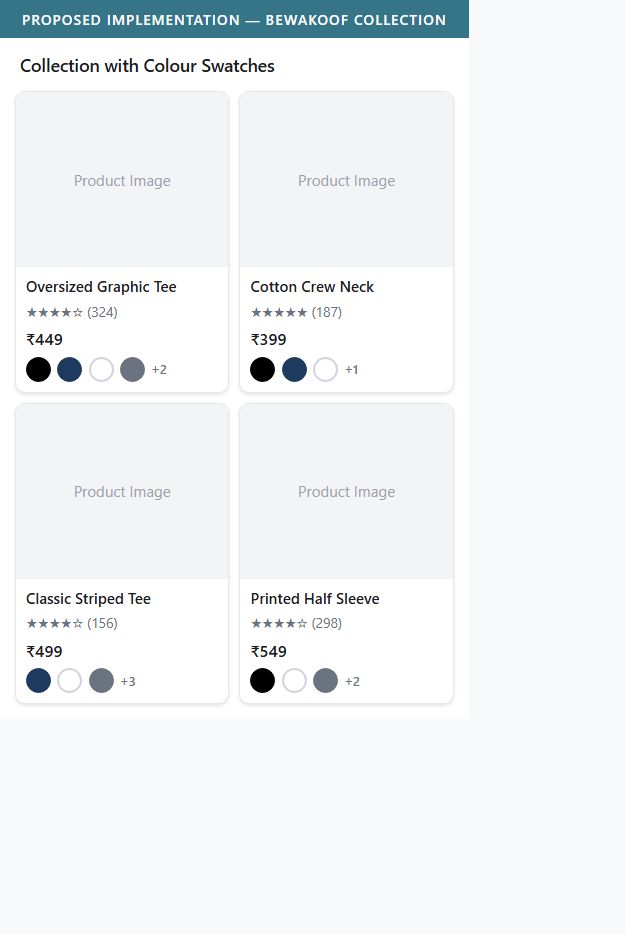
- Product cards show a single hero image with no colour variant dots or swatches
- Users have no signal on how many colour options exist without tapping through to PDP
- Multi-colour products are sold on a single card image, underselling the range available
- Competitors surface 3–5 colour dots inline, letting users pre-select before entering PDP
- Render up to 4 colour swatch dots on each product card; clicking a swatch should swap the card thumbnail to that colour and carry the selection into the PDP
- Add a '+N more' indicator when more than 4 colours exist to signal variety without cluttering the card
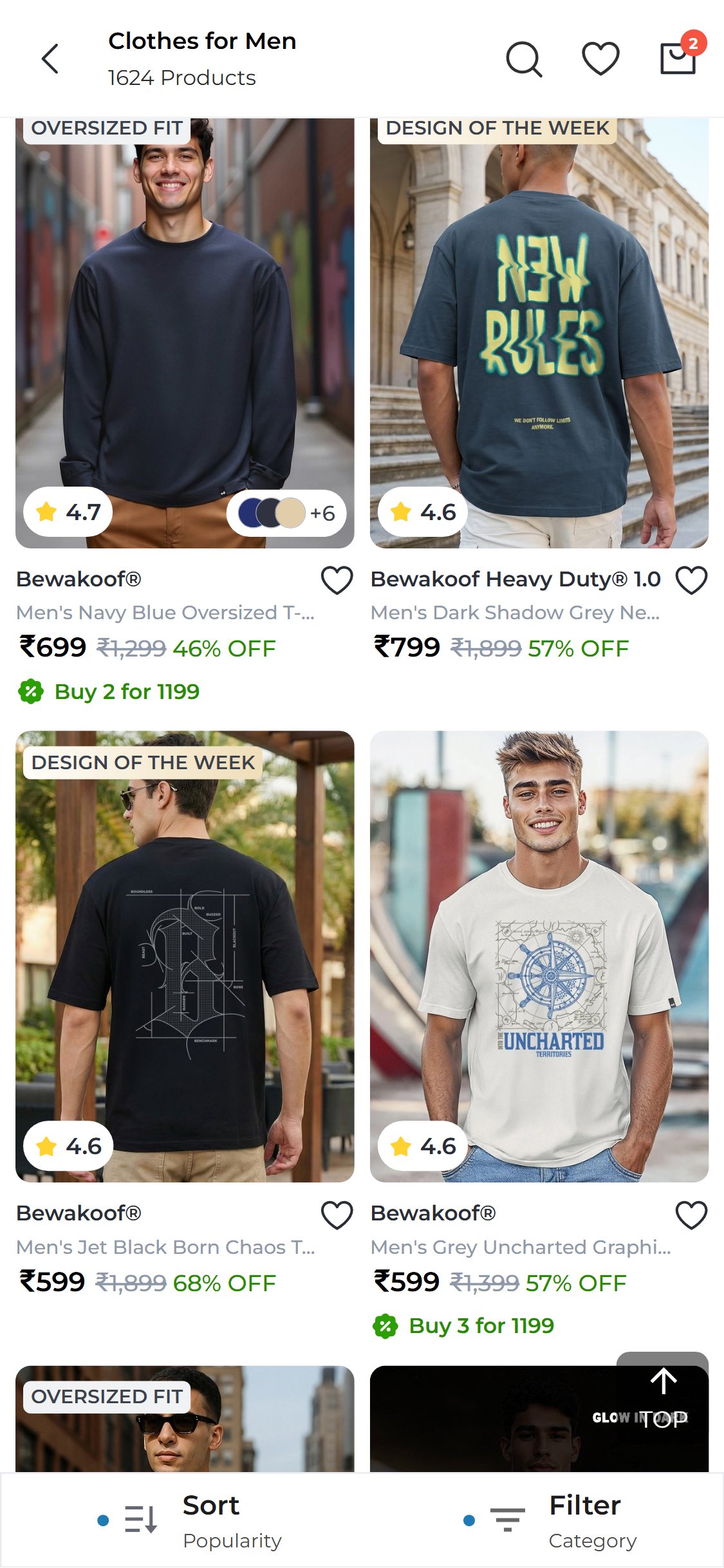
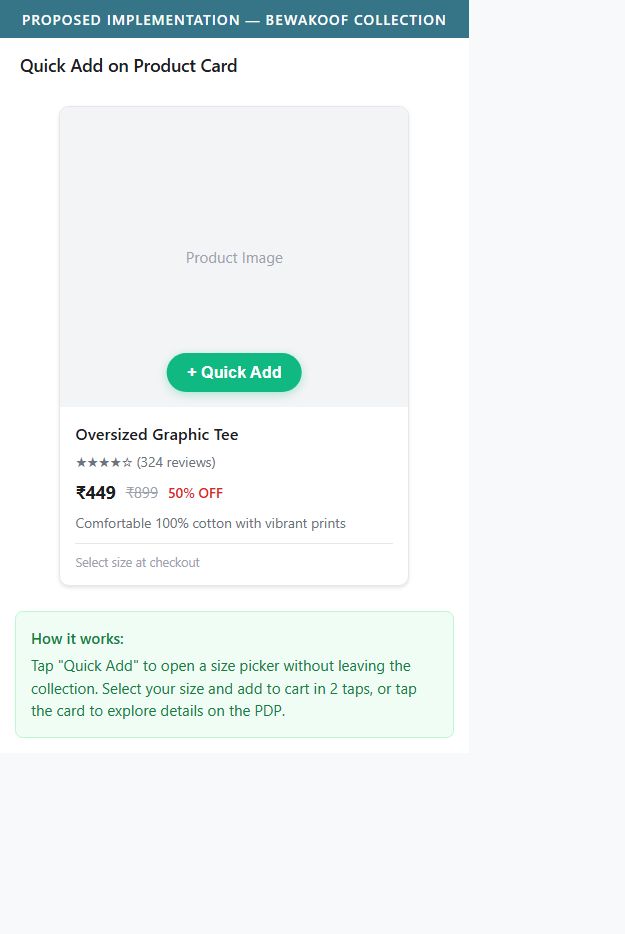
- Product cards have no hover/tap ATC button; the only action is navigation to PDP
- For repeat buyers or gifters who know their size, this adds 2–3 unnecessary taps per item
- Screenshot CP03_collection_no_quickadd.jpeg confirms no ATC surface on cards
- Growing adoption: 5–6 of top 10 Fashion stores now offer a quick-add or size-selector modal on cards
- Add a 'Quick Add' pill/button that appears on card tap-hold or as a persistent bottom strip, triggering a bottom-sheet size selector before adding to cart
- For products with only one size, allow direct ATC from card without a modal to reduce friction further
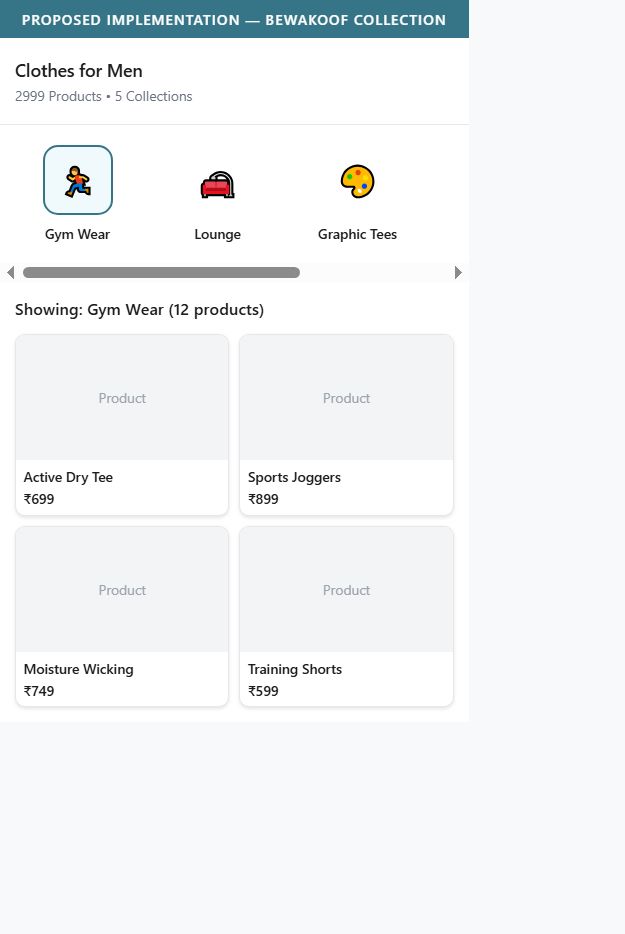
- Collection pages jump straight into the product grid with no contextual sub-navigation
- Occasion intent (workout, casual, travel) is not addressed via any filtering or tile shortcut
- Bewakoof's range (everyday, graphic, activewear) maps well to occasion segmentation but this is unexploited
- Lifestyle-based navigation tiles have shown strong engagement uplift on fashion DTC brands in India
- Introduce a horizontal scrollable tile row below the collection hero (icons + label: 'Gym Wear', 'Lounge', 'Graphic Tees', 'Hoodies') that deep-filters the grid
- Use contextual imagery per tile (product flat-lay or model shot) to make tiles shoppable and visually engaging
- No star-rating widget, review count, or individual review is visible anywhere on the PDP
- First-time visitors have no peer validation to overcome purchase hesitation on apparel
- 70% of top Fashion India stores surface star ratings above the fold on PDP
- Absence of reviews is particularly impactful for graphic tees where fit and print quality are key concerns for new buyers
- Integrate a reviews platform (Judge.me, Yotpo, or Okendo equivalent) and display the aggregate star rating + count immediately below the product title on PDP
- Show 3–5 most recent / most helpful reviews inline with a 'See all N reviews' expand link; include a photo review section to build visual trust
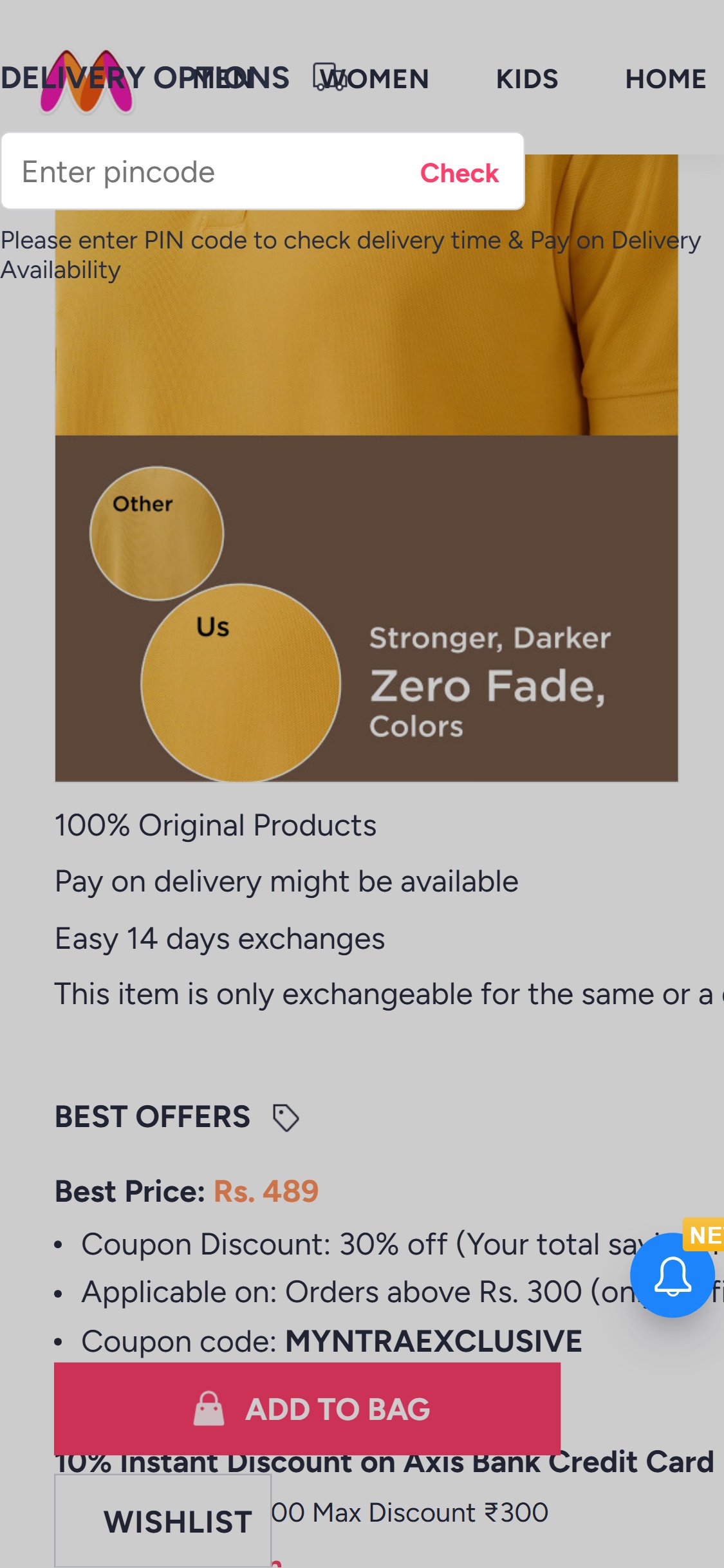
- The Add-to-Cart button is positioned within the normal page flow and scrolls out of view as users read size/description content
- Re-acquiring the ATC button requires scrolling back up — adding friction at the highest-intent moment
- On mobile, the viewport shows only ~5–6 product images before content pushes the ATC off screen
- A sticky bottom bar with price + ATC is a baseline UX expectation on mobile commerce in 2024
- Implement a fixed bottom bar (56–64px) that appears once the inline ATC scrolls out of view, containing product price, selected size, and 'Add to Cart' CTA
- Ensure the sticky bar disappears when the native ATC is in view to avoid redundancy and visual clutter

- No trust badge row (Easy Returns / 100% Authentic / Secure Checkout) is present near the ATC
- Return policy and authenticity guarantee are mentioned only in the footer or a separate policy page
- 50% of top Fashion stores place a compact trust strip immediately below or above the ATC button on PDP
- First-time buyers on a DTC site without marketplace assurance need in-context trust signals
- Add a 4-icon trust strip (Easy 7-Day Returns | 100% Authentic | Secure Payment | Free Delivery above ₹499) placed between the ATC and description section
- Use monochrome icons to keep the design clean; each icon should link to the respective policy page for users who want detail
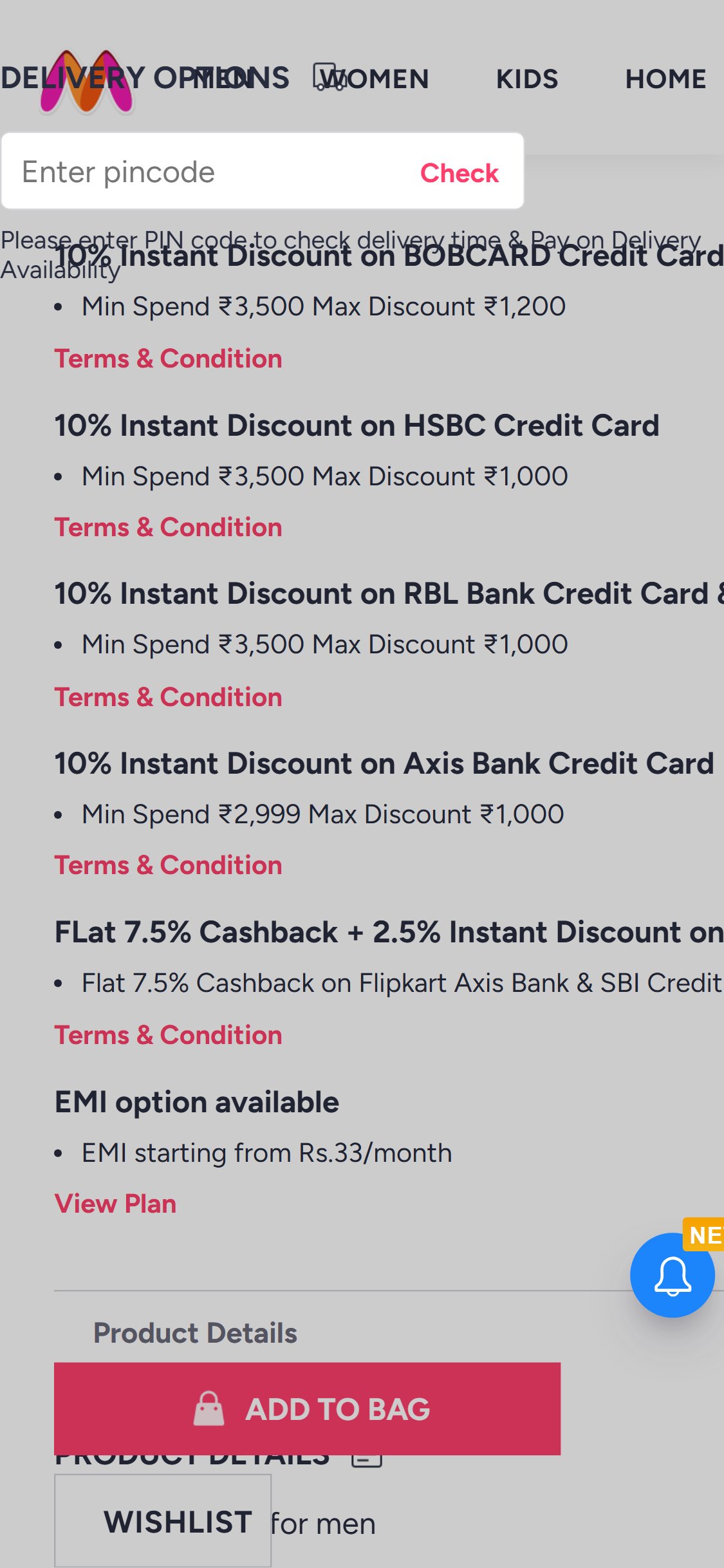
- Product price is displayed as a single lump sum with no EMI or BNPL breakdown nearby
- No 'Pay in 3 with Simpl' or 'No-cost EMI from ₹X/month' widget is visible on PDP
- 50% of top Fashion India stores surface BNPL/EMI messaging inline on PDP, especially for orders above ₹999
- Bewakoof's average basket likely qualifies for multiple BNPL schemes (Simpl, ZestMoney, Snapmint) but this is not communicated
- Add a one-line BNPL widget below the price (e.g. 'Or ₹X/month with Simpl | No-cost EMI available') with a tap-to-expand detail panel
- Partner with 2–3 BNPL providers and surface the lowest installment amount to make higher-priced items feel accessible
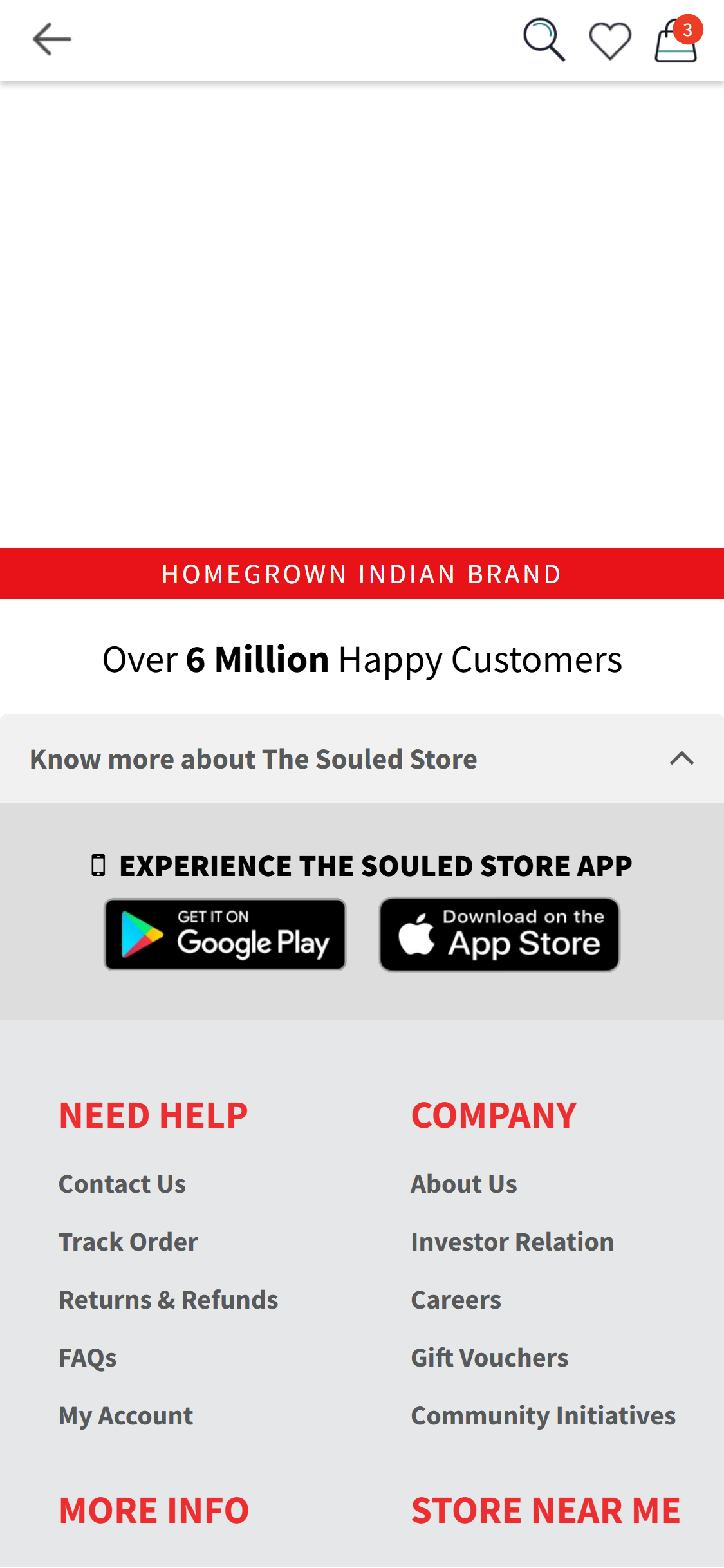
- Size selector is present but no 'Size Guide' link or measurement chart is accessible from the PDP
- Shoppers unfamiliar with Bewakoof's sizing (especially new customers) cannot validate their size choice without leaving to search externally
- Returns due to sizing are a major cost driver in apparel e-commerce — guidance reduces this
- Myntra, Ajio, and The Souled Store all surface size charts via a tap-to-open modal directly on PDP
- Place a 'Size Guide' hyperlink adjacent to the size selector that opens a bottom-sheet with a measurement chart and model measurement reference
- Consider a 3-question fit finder ('What is your chest size? How do you prefer your fit?') that recommends a size to reduce decision anxiety
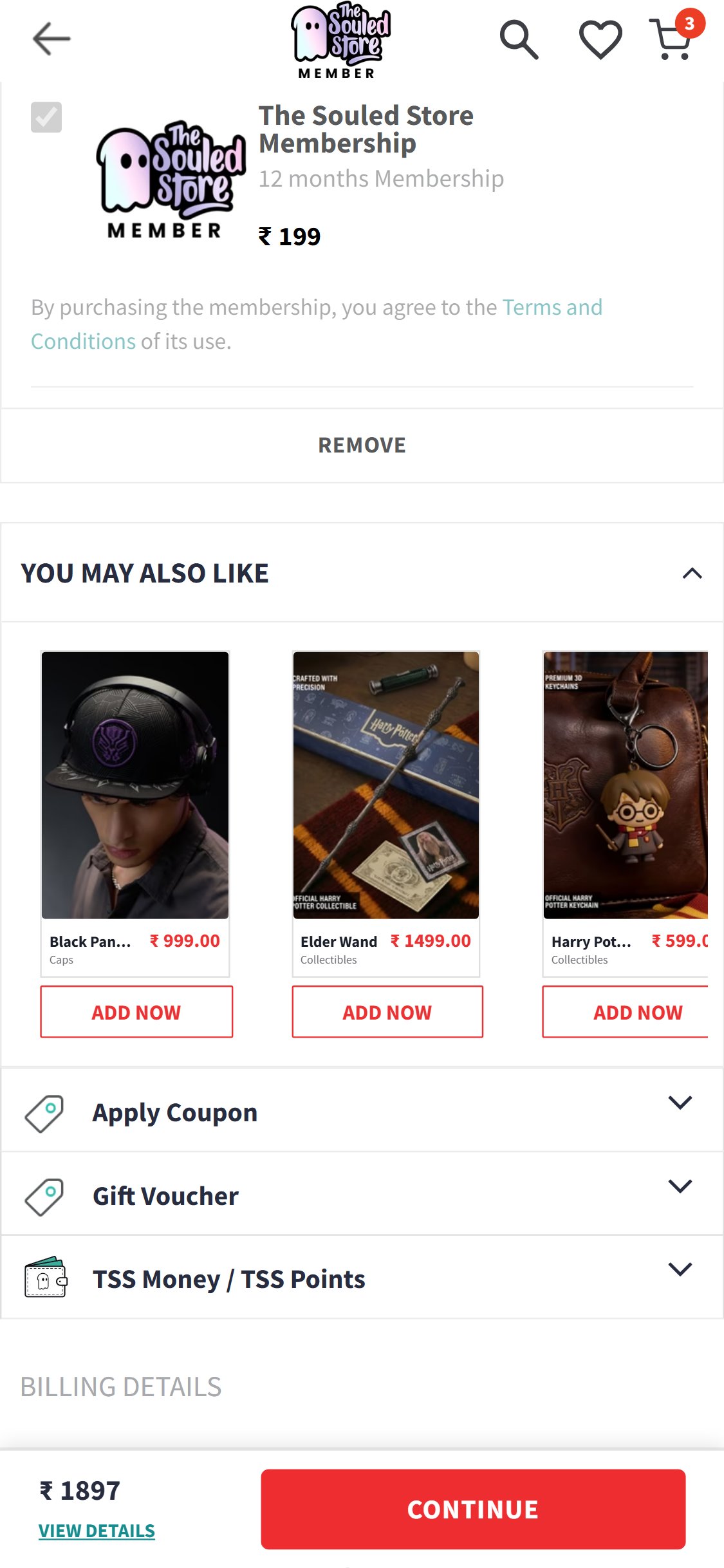
- The cart page displays line items and a checkout CTA with no product recommendations
- No 'Complete the look', 'Customers also bought', or 'Add these to your order' widget is present
- 70% of top Fashion stores inject at least one recommendation carousel in the cart
- Cart is a high-intent context — shoppers are already committed to buying and are highly receptive to relevant add-ons
- Add a horizontally scrollable 'You might also like' or 'Complete the look' product row in the cart, below the line items
- Use cart contents to personalise recommendations (e.g. if a graphic tee is in cart, show matching joggers or caps) to maximise relevance and AOV
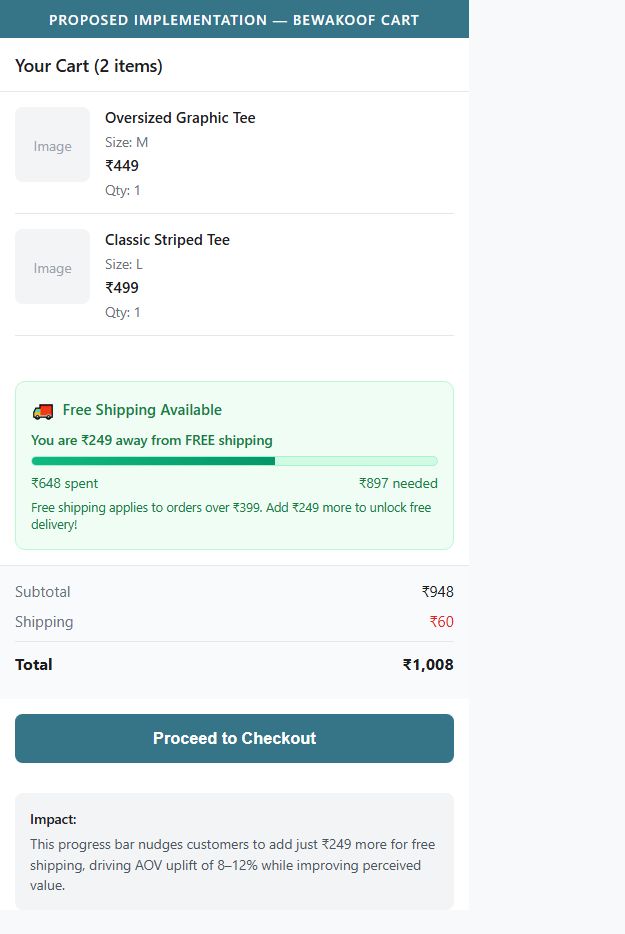
- Cart summary shows total amount and shipping cost as static values without motivational context
- No 'Add ₹X more for free shipping' progress indicator is present
- 60% of top Fashion stores use this pattern to convert the intent to save-on-shipping into AOV uplift
- Bewakoof's free shipping threshold (if any) is not communicated anywhere in the cart flow
- Add a progress bar near the top of the cart summary: 'You are ₹249 away from FREE shipping' with a visual fill bar that updates dynamically as items are added
- Pair the progress bar with a quick-add recommendation for items priced near the remaining threshold gap
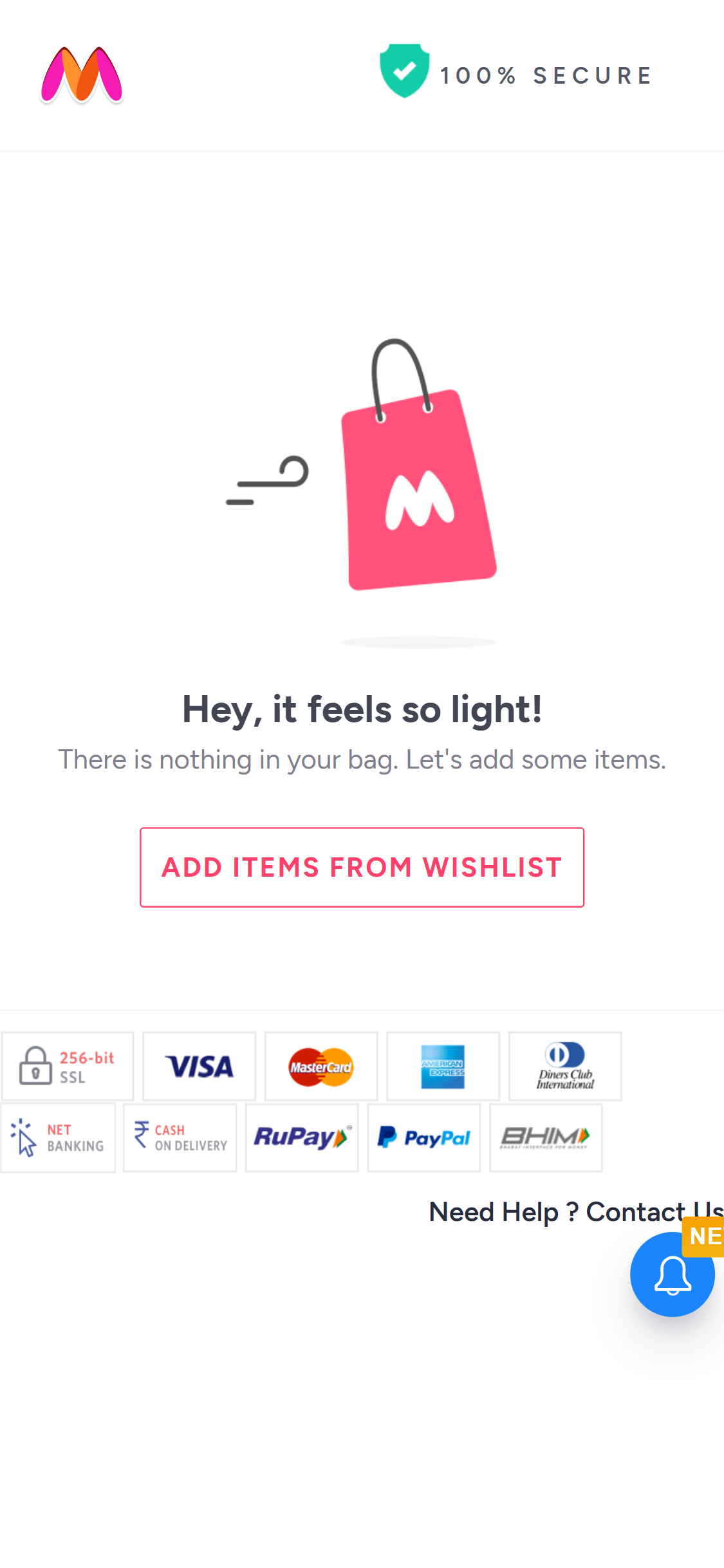
- The 'Proceed to Checkout' button in cart has no surrounding trust signals
- No payment method icons (UPI, Visa, Mastercard, Razorpay, COD) are shown near the CTA
- No 'Secured by SSL' or lock icon is visible to reassure first-time buyers at the critical drop-off point
- Cart abandonment is highest at this exact point — trust iconography is a low-cost intervention
- Place a row of payment method icons (UPI logo, card logos, COD label) immediately below the checkout CTA button
- Add a single line of microcopy ('100% Secure Checkout · SSL Encrypted') with a small lock icon to address last-mile hesitation
Performance & Technology
Core Web Vitals, page-speed signals, and the technology stack powering Bewakoof
Core Web Vitals
Technology Stack
Performance & Technology Assessment
Mobile performance is needs work (20/100); desktop is needs work (26/100) on Custom (in-house built). Page-speed and Core Web Vitals are increasingly load-bearing for SEO and conversion in this category — addressing the weakest vital first is the single highest-leverage technical improvement available.
PageSpeed vs Competitors
| Site | Mobile | Desktop |
|---|---|---|
| This site | 20 | 26 |
| The Souled Store | 29 | — |
| Myntra | 25 | 53 |
| Zudio | 100 | 25 |
Confidential — Prepared for Bewakoof by Growisto | May 2026
Technology Ecosystem
Technology stack assessment — installed tools vs recommended additions for Custom (in-house built) stores
Present (4)
Missing (5)
App Stack Assessment
Bewakoof's custom platform means it lacks the plug-and-play app ecosystem that Shopify competitors enjoy. Critical gaps in reviews and loyalty programs represent the highest-impact opportunities. Engineering effort is the main constraint, not budget.
Confidential — Prepared for Bewakoof by Growisto | May 2026